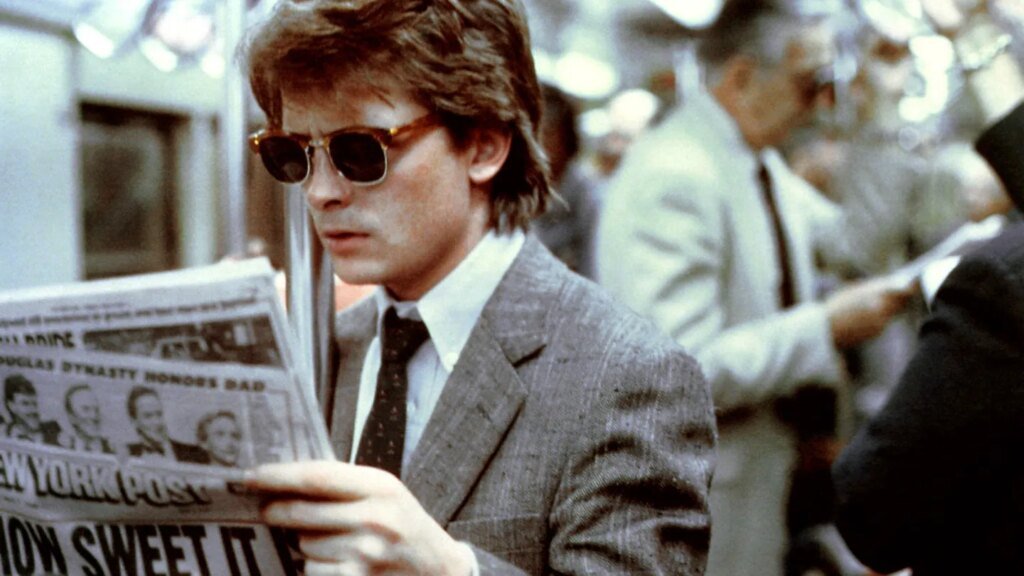
On April 1, 1988, United Artists released Bright Lights, Big City, an adaptation of the buzzy Jay McInerney novel, in theaters. The Michael J. Fox starrer went on to gross $16 million. The Hollywood Reporter’s original review is below:
Sometimes it’s just better to call in sick: That’s what Michael J. Fox concludes on one of his coke-binge days in Bright Lights, Big City, and what this frantic adaptation of Jay McInerney’s best seller might have done. McInerney fans may take a few sniffs opening weekend, and Fox fans may hole up for a couple weeks of curious glances, but Bright Lights boxoffice prospects seem mighty dim.
While more than Less Than Zero, this down-slide chronicle is less than compelling. Its strongest suit is Michael J. Fox who stars as an aspiring novelist, toiling away as a fact verifier for a snooty New York magazine. With his just-off-the-Corn-Flakes-box fresh looks and bouncy resilience, the energetic Fox is an engaging and likeable protagonist.
Bored with his tedious job, flattened by a wife (Phoebe Cates) who has cavalierly deserted him, the spry little guy is feeling the punches. Coked to the gills and exhausted by his fast-line life, the responsible and ambitious young writer is literally killing himself with cocaine, trying to keep up with a parastic friend (Kiefer Sutherland) who gets started every night around bar time.
Fox’s life is figuratively going down the toilet, where he, not surprisingly, spends much of his time lining out: He’s losing it on all fronts, screwing up at work and neglecting his personal life. The plucky kid who seemingly had a fast-track job and a beyond-dreams wife is now desperately snorting it all away.
While Bright Lights is a clinically sound and narratively solid depiction of a sickness, this movie adaptation lacks the novel’s deliciously acerbic descriptions of New York’s sick social scene as well as its protagonist’s self-aware commentaries. Despite a juicily disturbed subplot involving a tabloid “coma baby,” whose ghastly predicament is wickedly counterpointed with Fox’s own sickness, Bright Lights is a surprisingly bland offering.
Yet, where Bright Lights shines, and where its intermittent power lies, is with Fox’s wonderfully resilient performance. Remarkably strong and decidedly decent, he’s able to charm and bluff his way through the terrors of his addiction. As he slips and slides, even when bottomed out, Fox is completely sympathetic and engaging. Indeed, this dichotomy within Fox’s character — that the strength that allows him to rebound is also the source of his spiraling disease — is astutely conveyed in Jay Mclnerney’s shrewdly developed screenplay. His raging sickness is realistically captured under James Bridges’ character-sensitive direction.
Nevertheless, Bridges, while eliciting strong performances from his well-chosen cast, has patched together a decidedly innocuous portrait of this horrifying disease. Visually and viscerally, Bright Lights is about as captivating and unremarkable as municipal building artwork. Even the daily abrasions of living in New York, including Fox’s forays into the mind-numbing night life, seem unexpectedly pedestrian.
In essence, Bright Lights, Big City, instead of being emotionally provoking and riveting, is distressingly gray and tedious, enlivened only by Fox’s gifted histrionics.
Surrounding Fox’s keen central performance are a number of skilled and sensitive portrayals, in particular Swoosie Kurtz, as a lonely co-worker who is genuinely concerned about her young cohort’s well-being. In one languid, literary and lethally liquid lunch, Jason Robards gives a wonderful multimartini turn as a burned-out editor, while Keifer Sutherland is splendidly charming and callous as Fox’s so-called friend.
John Houseman tippy toes briefly as a dry old bean and stuffy grammarian, emblematic of the stultified staff at Fox’s magazine of employment; unfortunately, Houseman’s marvelously fussy presence is only one of the film’s intermittent garnishes, most of which are never developed and never pay off. — Duane Byrge, originally published on March 31, 1988.
Kiefer Sutherland, Phoebe Cates and Michael J. Fox in 1988’s ‘Bright Lights, Big City.’
United Artists/Courtesy Everett Collection