There’s a scene in the trailer for the 30th Oldenburg International Film Festival that tells you everything you need to know about the event. Festival co-founder and director Torsten Neumann, half in shadow, delivers a brooding monologue inspired by Marlon Brando’s “The Horror” speech from Apocalypse Now — except here, the existential dread comes not from war but from programming an independent film festival with global ambitions in a midsize German city.
The production, cheekily titled Oldenburg Now, was shot in an office building across the street from festival headquarters, with staff hauling in houseplants to approximate a Vietnamese jungle. It’s indie filmmaking in its purest form — improvised, resourceful and entirely in sync with the ethos Oldenburg has cultivated over the course of three decades.
It is, in every conceivable way, a microbudget guerrilla filmmaking operation. And it is absolutely perfect. (It helps that the svelte but follicle-challenged Neumann bears a cranial resemblance to late-era Brando.)
That contradiction — an audacious creative vision executed on a shoestring — sits at the heart of what has made Oldenburg one of Europe’s most beloved indie showcases. Now in its 33rd year, the September gathering in Lower Saxony has built an international reputation not only for its programming of boundary-pushing independent cinema but for its marketing campaigns, which have become events in and of themselves.
Annual trailers and print ads — including a long-running presence in The Hollywood Reporter’s Cannes Dailies — have turned Oldenburg into a fixture of festival-circuit conversation.
“The shoots for the trailers reflect the independent drive of the whole festival,” says Katrin Brinkmann, who first came to Oldenburg as an intern and has worked on numerous campaigns. “We’re scouting for empty spaces, trying to make it look professional for no money. It’s the same energy as our filmmakers: You have an idea, and then you just figure out how to make it happen.”
The trailers lean hard into cinephile in-jokes, typically riffing on film history before colliding those references with the realities of running a defiantly non-mainstream festival. Oldenburg Now transplants Coppola’s Vietnam epic to northern Germany, ending with Neumann — to the sound of Wagner’s “Ride of the Valkyries” rising on the soundtrack —tucking into a local pastry: “I love the smell of [Oldenburg cafe] Janssen Brötlis in the morning.”
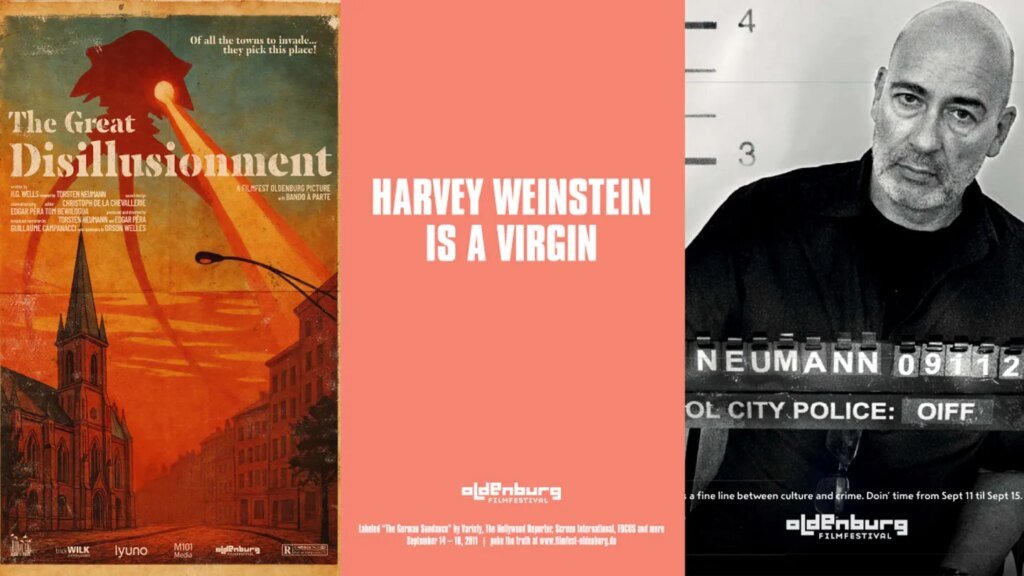
The Lost Oldenburg — from 2012, shot at Marvin’s, the city’s legendary dive bar — paid homage to Billy Wilder’s The Lost Weekend. Last year’s trailer, The Great Disillusionment, created by Portuguese surrealist director Edgar Pêra (Magnetick Pathways), a frequent festival guest, staged sci-fi invasions à la The War of the Worlds, complete with retro UFOs laying waste to the streets of Oldenburg.
“All the visual motifs in the trailers and in print are essentially love letters to the industry,” says Lukas Hausberger, another former Oldenburg intern who has worked as a designer on several campaigns. “They’re intended for people who catch the references and appreciate the inside jokes.”
While other festivals rely on external agencies and tend to settle on a generic style or recurring visual motifs — Berlin’s Bears, the Cannes Palmes — every year Oldenburg tears up its previous campaign and starts from scratch.
“The source of all the ideas is basically Torsten’s brain,” Brinkmann says. “He has this archive of concepts, and every year we sit down and figure out how to bring one of them to life.”
Neumann himself sees the campaigns as inseparable from the festival’s identity. “As with the programming, it’s always about a love for the margins of the film industry, where you often discover the best films,” he says.
That philosophy has produced some of the festival’s most memorable imagery. A 2014 “Icons” campaign, featuring a revolver cylinder and the tagline, “Five days to blow your mind — no liability for day 6,” became a cult hit, even winning a design award in Chicago and selling out T-shirts. “That was the festival’s image: Five intense days, then day six, the day after, is the hangover,” says Neumann.
For the 2024 campaign, Oldenburg festival staffers restaged iconic celebrity mug shots in a campaign that managed to be simultaneously irreverent, politically resonant and deeply film-nerdy. Neumann played the crestfallen Hugh Grant after his 1995 arrest for solicitation in Los Angeles; Brinkmann was more defiant, her left fist raised, in her imitation of Jane Fonda’s legendary arrest photo from 1970.
From left: The 2025 campaign drew inspiration from Powell and Pressburger’s classic ‘Black Narcissus’ and David Cronenberg’s ‘Naked Lunch.’
Courtesy of the Oldenburg Film Festival
Last year’s “Lose Your Religion”/“Addicted to Cinema” campaign was something completely different. Taking equal inspiration from the Powell and Pressburger classic Black Narcissus, David Cronenberg’s Naked Lunch and a ’90s PlayStation campaign (“Where the console buttons appear in the veins of a player’s hand,” notes Brinkmann), it mashed up religious, body horror and drug imagery to suggest that visiting Oldenburg would result in physical and spiritual transformation.
“Transgression is a crucial element in art, one that is in danger of disappearing,” Neumann says. “So our ads should push boundaries. We used a junkie’s arm in last year’s campaign, with its protruding veins forming the festival logo. It might seem shocking at first, but the message is clear: We are addicted to cinema — the festival is in our blood.“
For his ads, Neumann is a fan of using “false” claims that are qualified in small print. Like his “Harvey Weinstein Is a Virgin” ad — done years before #MeToo — “that made us the talk of the town in Cannes”; or one with the tagline, “Robert Redford Is the American Torsten Neumann,” spoofing the label many use to describe Oldenburg as the “German Sundance.”
This year’s campaign tackles the “truly dreadful genre of motivational calendar sayings,” with Fargo-style needlepoint murals and anti-inspirational slogans. “It’s never too late to give up your dreams” reads Day 1.
“There will be plenty of irreverence in the coming days,” Neumann promises, “and for the cinephiles, lots of little references to big films hidden within.”
Ultimately, the target audience for all this isn’t the broader industry but the filmmakers themselves — the outsiders, the rule-breakers, the ones Oldenburg programs. “We want to reach the people whose films we’ll later be showing,” Brinkmann says. “So they recognize themselves in it.”
That connection appears to resonate. Each year, the festival receives what Brinkmann describes as “little love letters” from attendees — messages about the intensity of the five-day experience and the sense of belonging it creates. The campaigns are designed to bottle that feeling and project it outward.
“Oldenburg can’t compete as a ‘marketplace’ where buyers and producers directly license talent and discoveries,” says Neumann. “But these days, an invitation to Oldenburg is a seal of quality because unlike many other festivals, we are very radical in our evaluation criteria: We don’t have to consider any film policy arguments, there are no quotas to meet, and we will never prioritize other criteria over cinematic quality.”
And it’s a connection that has helped nurture filmmakers early in their careers. “Filmmakers like Sean Baker showed their first films in Oldenburg,” Neumann says. “And Sean’s clear rejection of all expectations now that he’s making studio films for big bucks is a source of hope for the survival of independent cinema and a confirmation of our tenacity in our struggles.”