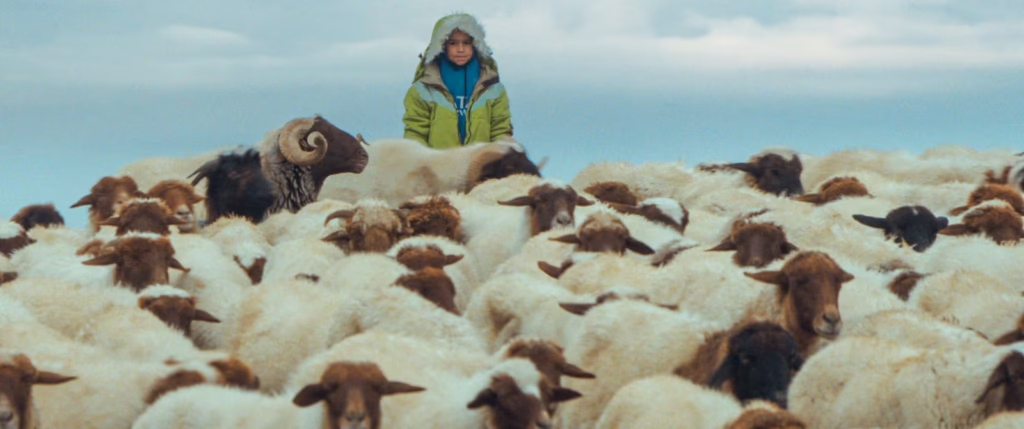
It’s complicated! The world’s largest solar power plant is being built in Morocco, with the aim of turning arid land into a “green energy source.” So far, so good, you say? But wait, there’s a catch! After all, barriers go up, and access to water becomes difficult. And members of the local Berber tribe, the indigenous Nomad population, are given no choice but to work for the power plant.
In The Price of the Sun (Du soleil et du plomb), Belgian director Jérôme le Maire (Burning Out, Tea or Electricity) zooms in on the ambiguities and hidden costs of progress and “the resilience and adaptability of a community forced to reinvent itself in the shadow of the renewable energy revolution.” The film world premieres on Saturday, April 18 in the international feature film competition program of the 57th edition of the Visions du Réel documentary festival in Nyon, Switzerland.
With cinematography from Olivier Boonjing and le Maire and editing by Matyas Veress, The Price of the Sun shows us how the nomads’ traditions exist in quiet conflict with the drive to supply renewable solar and wind energy to the world. “Ironically, the fight for resource control to connect the world may ultimately destroy a society that, by definition, shares resources and is obliged to be connected,” highlight the press notes for the doc. “Can there be enough sun and wind for everyone, or is the price too high?”
Or as le Maire mentions in a director’s statement: “I strove to achieve precise and intimate observation of these nomads and the values they cultivate, up until the moment they are confronted with the arrival of an unavoidable event that will lead them toward an unexpected future.”
‘The Price of the Sun,’ courtesy of Jérôme le Maire
Ahead of the world premiere of the film, le Maire shared with THR how The Price of the Sun came about, his focus on the potential cultural ambiguities of renewable energy, and what’s next for him.
How long did you work on this film, and how did you get access to the Berber tribe and the power plant workers? There must have been so much trust!
In short : The shoot consisted of 12 two-week stays spread across six years (January 2019 to September 2025), totaling approximately 168 shooting days. But location research began in 2017 with a year-long investigation around the Noor Ouarzazate power plant, followed by four two-week stays in 2018 – getting to know the Ait Merghrad community and exploring the region around the future Midelt plant site. So the film was in production for approximately eight years, from initial scouting in 2017 through the final shoot in September 2025.
The secret to making this kind of film is to take your time. To take the time to introduce yourself. Who am I, and what am I doing in this region? What can I do for you? Before I say what I want to film, I listen to what these people have to say, where their words come from. And in doing so, I discover myself, too, gradually.
The first time I went to this desert to scout locations, I was with my wife. She just adores these regions of southern Morocco. Another time, I was with my daughter. To gain someone’s trust, you have to offer an exchange. I’ll show you who I am, and you show me who you are.
And then we talked about the power station. The tribe had its opinion. I had mine. We discussed at length what was unfolding before us. We were trying to make sense of it all. We were trying to understand one another. On one side, you have those who need energy, and on the other, those who will produce it, or enable its production.
The nomads quickly realized that what interested me was less the power station itself than the ecosystem in which it was to be built. As a result, they became part of the story. It is rare for them that an “outsider,” someone who is not one of them, takes an interest in their lives. They were touched by my proposal to make a film about them, amidst the turmoil that was looming.
I also built a relationship of trust with the plant’s management. Here, it is first and foremost an institution. I know how this sort of organization operates, and in such cases, you must first prove your credentials. You have to show who you know, what your credentials are. So, I show the films I’ve made and the success they’ve had. Then, I use the connections I have in high places. But in the end, it’s always the same: you find yourself face to face with a human being, and at that point, you have to be yourself and clearly show who you are. Face to face, I don’t put on an act. I connect with the person and speak to them very sincerely. In high society, people aren’t really used to that sort of frankness, so it works very well.
For this film, I had the opportunity to meet Morocco’s Minister for Energy Transition, and we hit it off immediately. I introduced myself very simply, being completely myself. I didn’t really follow protocol; I focused on frankness and spontaneity. During the meeting, she and I came up with a plan where she would come to the site to meet the nomads I’d been telling her about in person. Unfortunately, it didn’t happen. It’s a shame, as they were looking forward to welcoming her. But the most important thing for me was to speak directly to the minister about these ordinary people. She knows they exist and that she’s welcome in their homes!

‘The Price of the Sun,’ courtesy of Jérôme le Maire
How would you describe your approach to doc-making in general? Do you always look for an observational/vérité approach and why?
All my films are made in the cinéma vérité style, which we also call “direct cinema” here. Personally, I really enjoy immersing myself in worlds that are very different from those I know. I act as if I were a resident of a remote mountain village, as in Tea or Electricity, or as a member of an operating theater team, as in Burning Out. I become part of the community, whether or not I appear as a character in the film. I chart the path myself, and I invite the audience to follow it. And I film in such a way that it creates this impression. The impression of being there yourself in the desert with the nomads.
The audience loves this kind of documentary because a story is told to them and, just like in fiction films, they are allowed to navigate the narrative. They are free to form a bond with a particular character and to think whatever they like about what is happening. There is no voice-over to explain, inform or dictate a particular way of thinking. In cinéma vérité/cinéma du réel, viewers are fully immersed in a world; they experience emotions, and they interact internally with the characters and with what happens to them.
This kind of cinematic experience can leave a deep impression on us. What matters to me, as a director, is to connect the audience intimately with people who are experiencing very different things thousands of miles away. To ensure that those who watch my film can, for a moment, put themselves in the other person’s shoes – and thus, perhaps, shift their perspective away from the dominant narrative.
You show us all sorts of ambiguities, such as the benefits of building renewable energy plants, but also the downside of cultural imposition on a native tribe. How did you approach how to balance the good and the bad, and how did you think about taking sides or not?
This has been a long journey for me, documenting how these energy projects have displaced nomadic people from their traditional lands, disrupted their way of life, and highlighted the broader implications of modern renewable energy development. The nomadic way of life emphasizes the importance of simplicity and respect for the environment. I want this film to question the philosophical dimension of this new “green energy,” described as “clean” and undeniably “sustainable.”
I want to shine a spotlight on the vision and question the transaction [involved in it]. I hope audiences become more aware of the invisible people and businesses affected by their energy consumption, and that will urge them to reconsider their reliance on both electricity and technology.
But what this film, in essence, shows is that clean energy does not exist. It is sold to us as such so that we consume ever more, without a twinge of conscience. Yet today, it has become absolutely vital to take energy-saving measures – both at an individual level and at a public level. We absolutely must consume less. It is the only lever that guarantees 100 percent positive effects for the planet and the common good.
When you use artificial intelligence, when you charge your electric car or when you flick the light switch in your living room, there is someone at the other end of the power cable who will be affected by that consumption. It is not about guilt, but about awareness and responsibility!
‘The Price of the Sun,’ courtesy of Jérôme le Maire
What was the hardest part of making this doc?
Filming in the lead mines was difficult! These places are extremely dangerous, so filming there is a very delicate matter. We had to ensure there were no accidents. Yet accidents are common in these mines because the work is unsupervised. It involves just a few dozen poor people who have taken it upon themselves to work as miners. They have no equipment whatsoever. And whilst they know the place well, they have only a very limited understanding of the work involved. In fact, they can rely only on their courage and the solidarity between them. So that’s where I started.
It’s this “set-up” that I had to fit into. The sound engineer didn’t feel comfortable going down with me. My daughter, who was the assistant director, didn’t want to go down either. So I went down alone, with the lads. These were intense moments because at that point, I was completely united with them. We helped each other; we each had a goal, but the path we were taking was the same.
I’m very pleased with these scenes. You really feel that descent into the bowels of the earth. The imagery is flawless; the camera work was superb. What’s more, the story this part tells is truly incredible. As I filmed Aziz hammering away like a madman to extract lead from the rock, I thought of him – just a few months earlier, he was still a shepherd. I was really moved. I sincerely hope this film can help improve his situation!
What are you working on next?
I’m currently working on a very different project: I’d like to cross the High Atlas mountains in Morocco all alone, on foot, with a mule! So I’m preparing for this expedition, which is likely to take me several months. I need to recharge my batteries. To reflect on the meaning of life. To disconnect from this fast-paced, talkative world… and from this culture of overconsumption!
I’m going to walk a thousand kilometers along this magnificent mountain range, dotted with little villages that seem to exist in another world, in another time. Perhaps I’ll take a camera with me and end up making a film…